The gap
AI use has outrun AI governance
Sources: McKinsey, The state of AI in 2025; IBM, Cost of a Data Breach Report 2025.
How it works
Five steps from inventory to board-ready dollars
Each step leaves a record that the next step, the board and your regulator can use.
- Step 1
Register
Every AI system, built, bought, embedded in SaaS or adopted by staff, with an owner. A short intake before anything new.
- Step 2
Classify
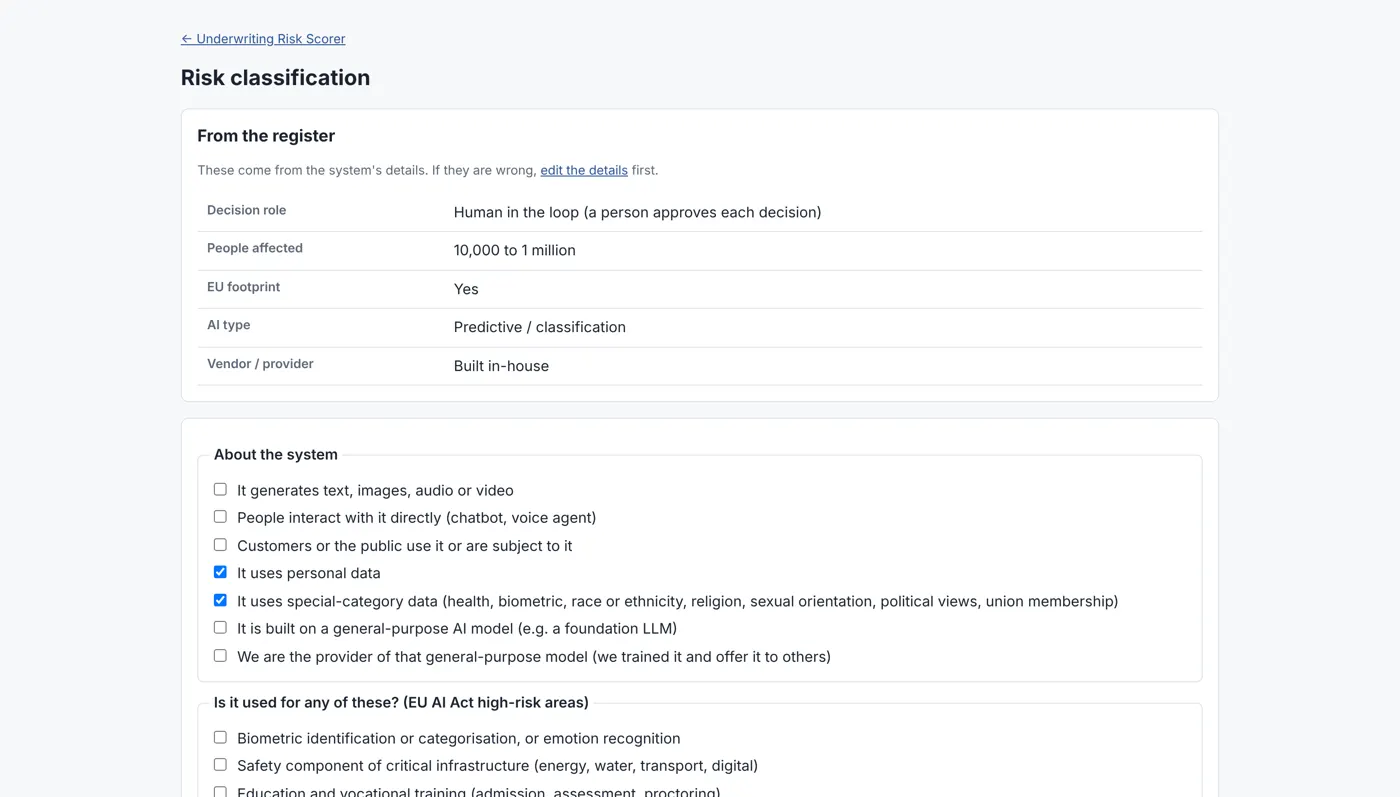
EU AI Act tier and internal risk level, with the reasons and dated obligations.
- Step 3
Price
Estimated exposure in dollars through ValuRisQ: residual risk, data theft and interruption.
- Step 4
Control
Lifecycle gates, committee decisions, signed policies, ISO/IEC 42001 and NIST AI RMF controls.
- Step 5
Monitor and report
Monitoring checks, incidents, regulator notice deadlines and a quarterly board pack.
Product tour
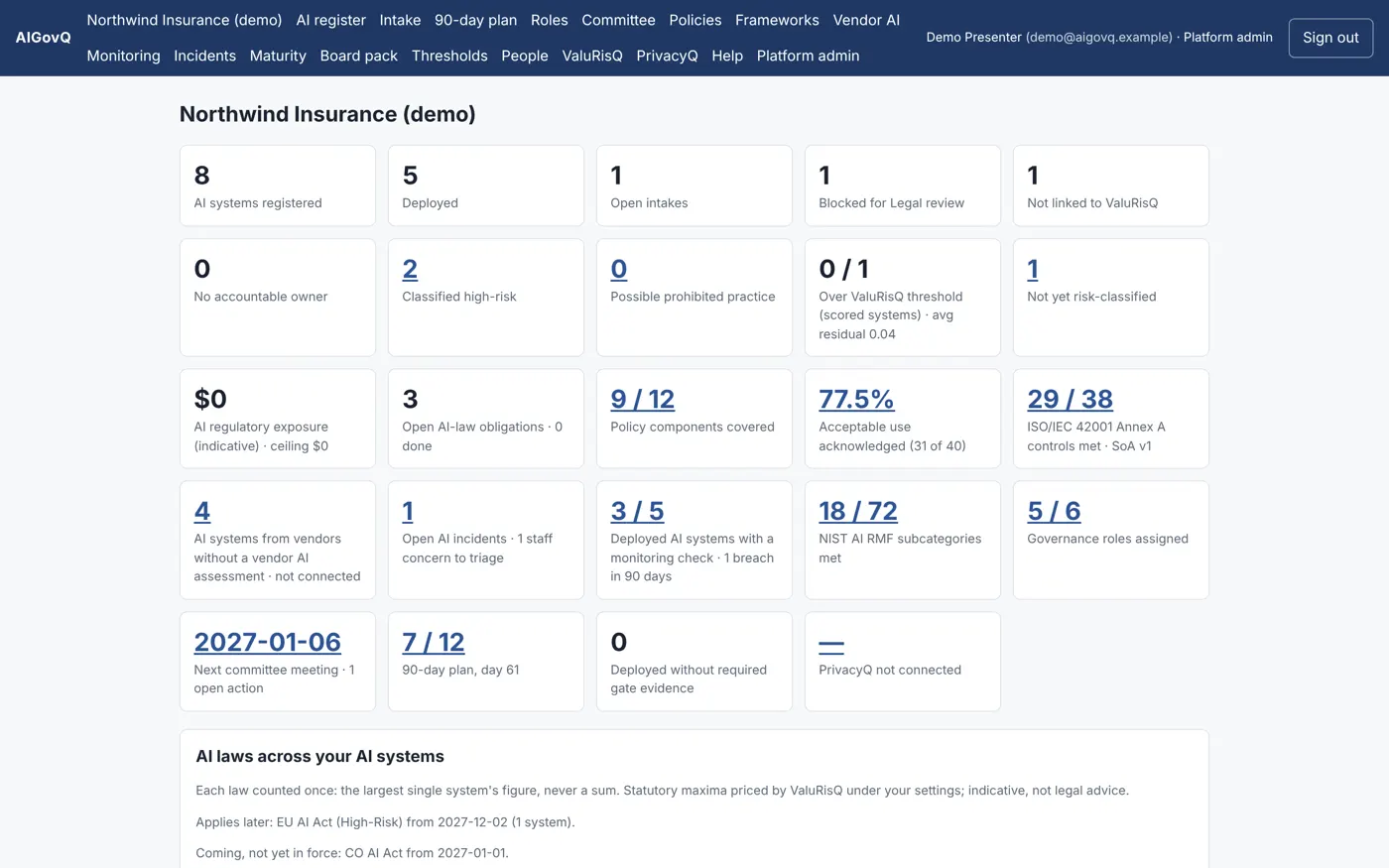
See the product, not a mock-up
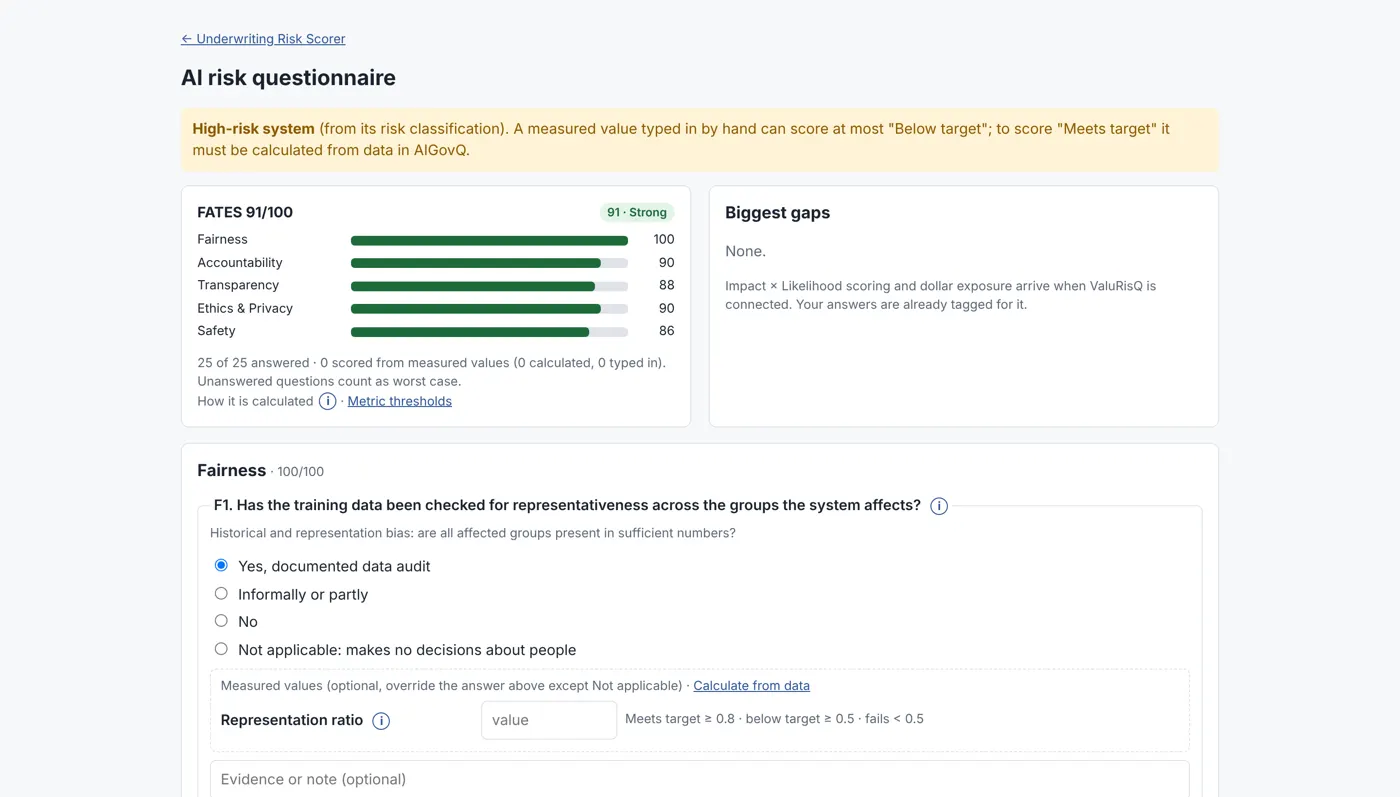
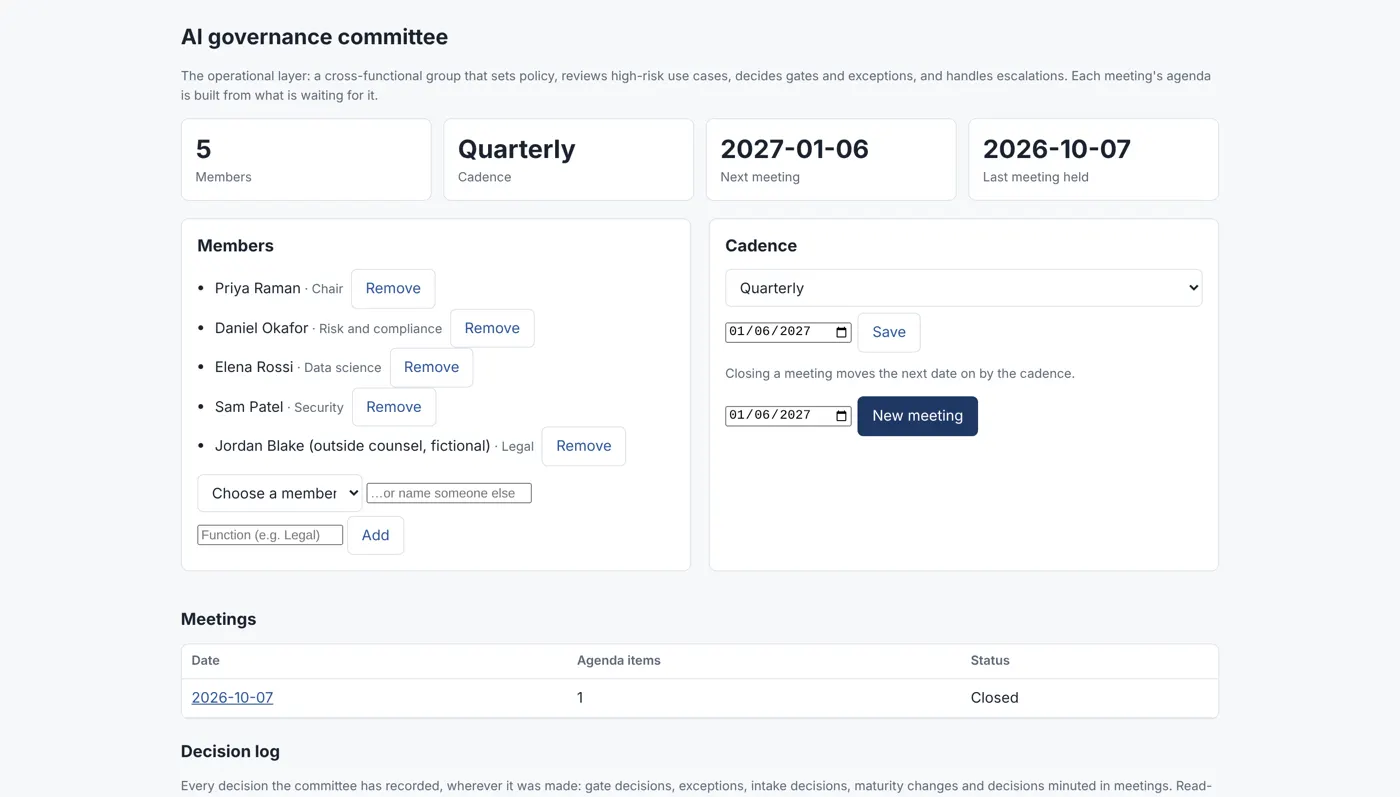
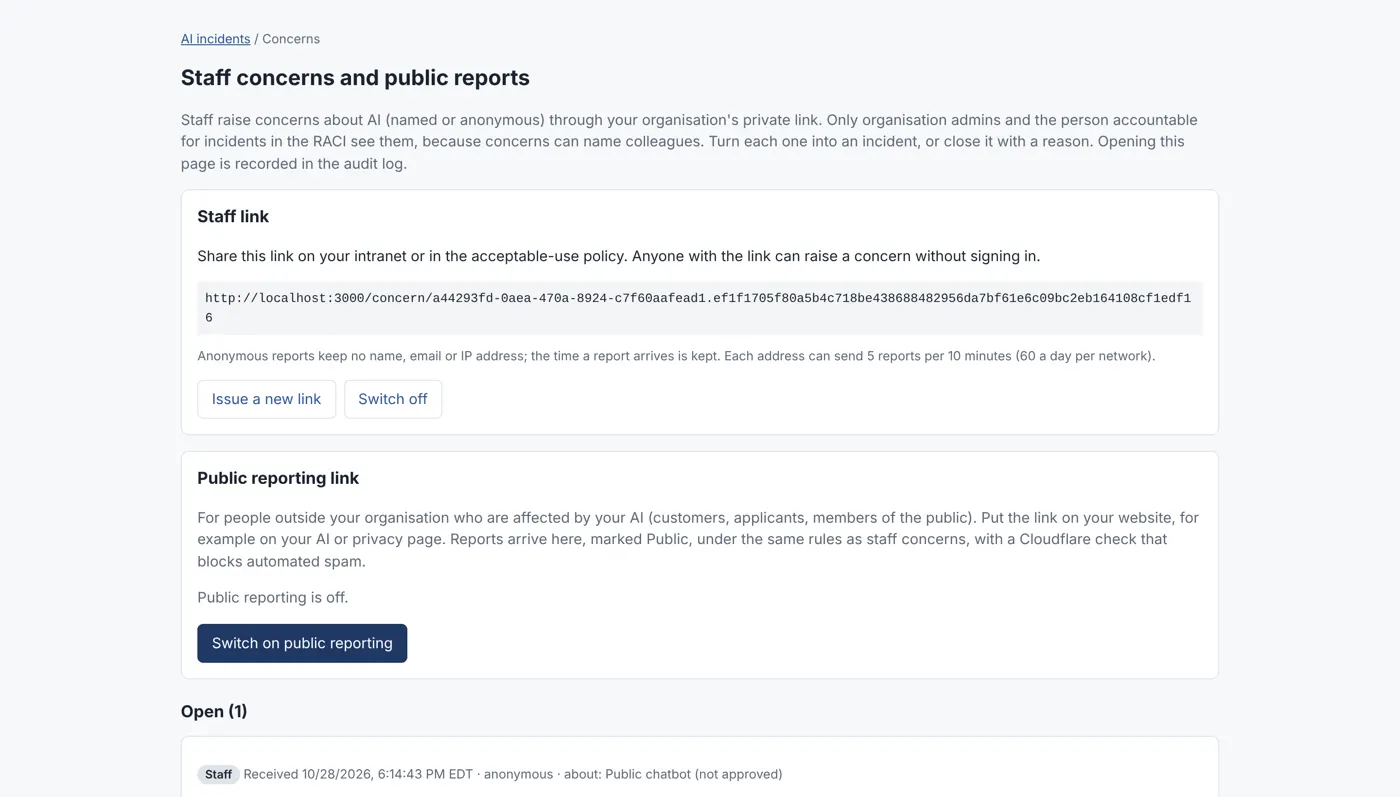
Every screen below is the real application, running the fictional Northwind Insurance demo organisation.
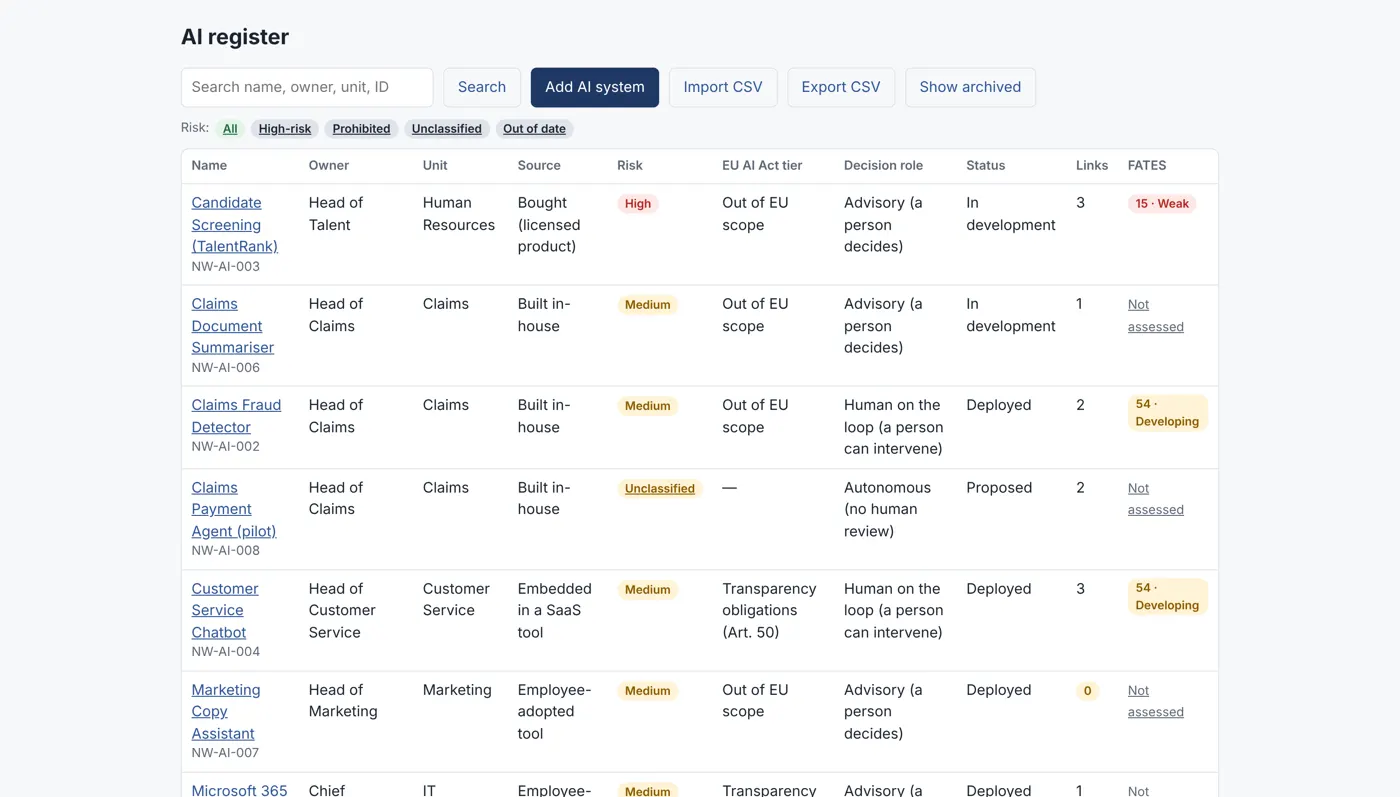
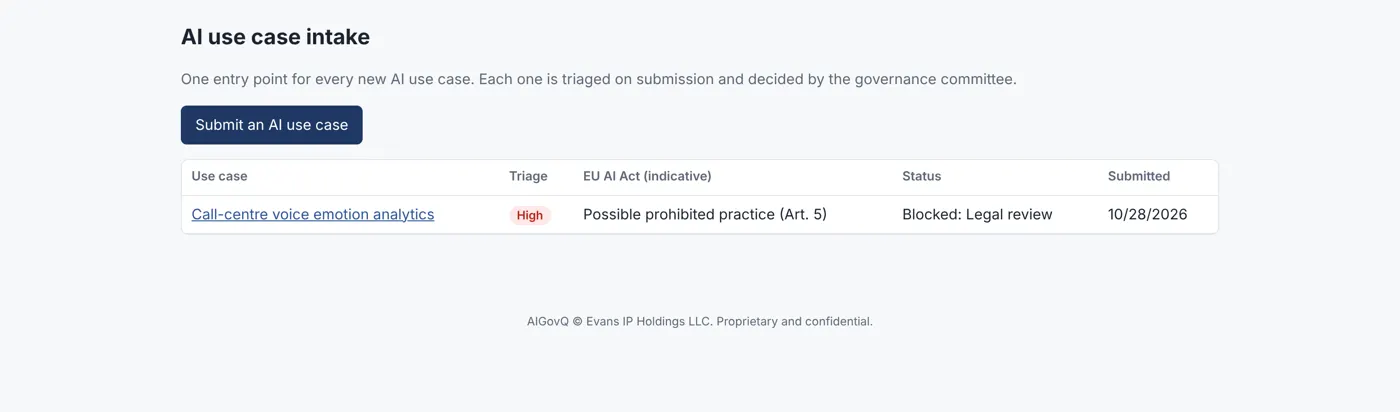
Find every AI system, and stop problems at the door
One list for models you build, AI you buy, AI inside SaaS tools and tools staff adopt on their own.
- Owner, unit, source, decision role, people affected and status for each system
- Filters for high-risk, prohibited, unclassified and out-of-date entries
- CSV import and export to bring in your existing list
- A short intake before anything new; possible prohibited practices go to Legal automatically
Classified with reasons, priced in dollars
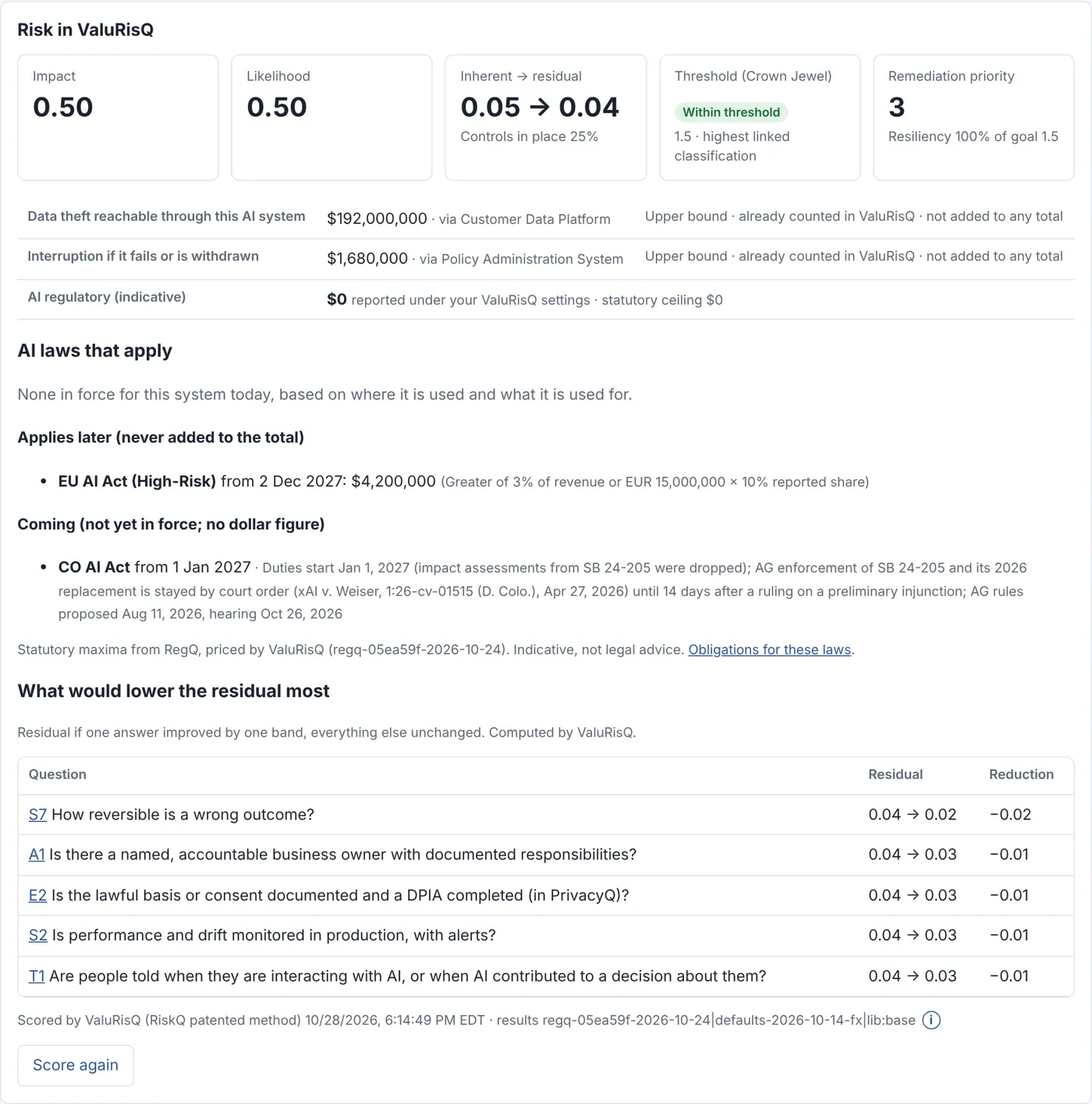
Each system gets an EU AI Act tier and an internal risk level, with the reasons and obligations. Connected to ValuRisQ, it shows the exposure a board can weigh against a budget.
- Impact, likelihood, inherent and residual risk against your threshold
- Data-theft and interruption exposure through the systems it touches
- AI laws that apply, with indicative statutory ceilings and start dates
- The answers that would lower the residual most
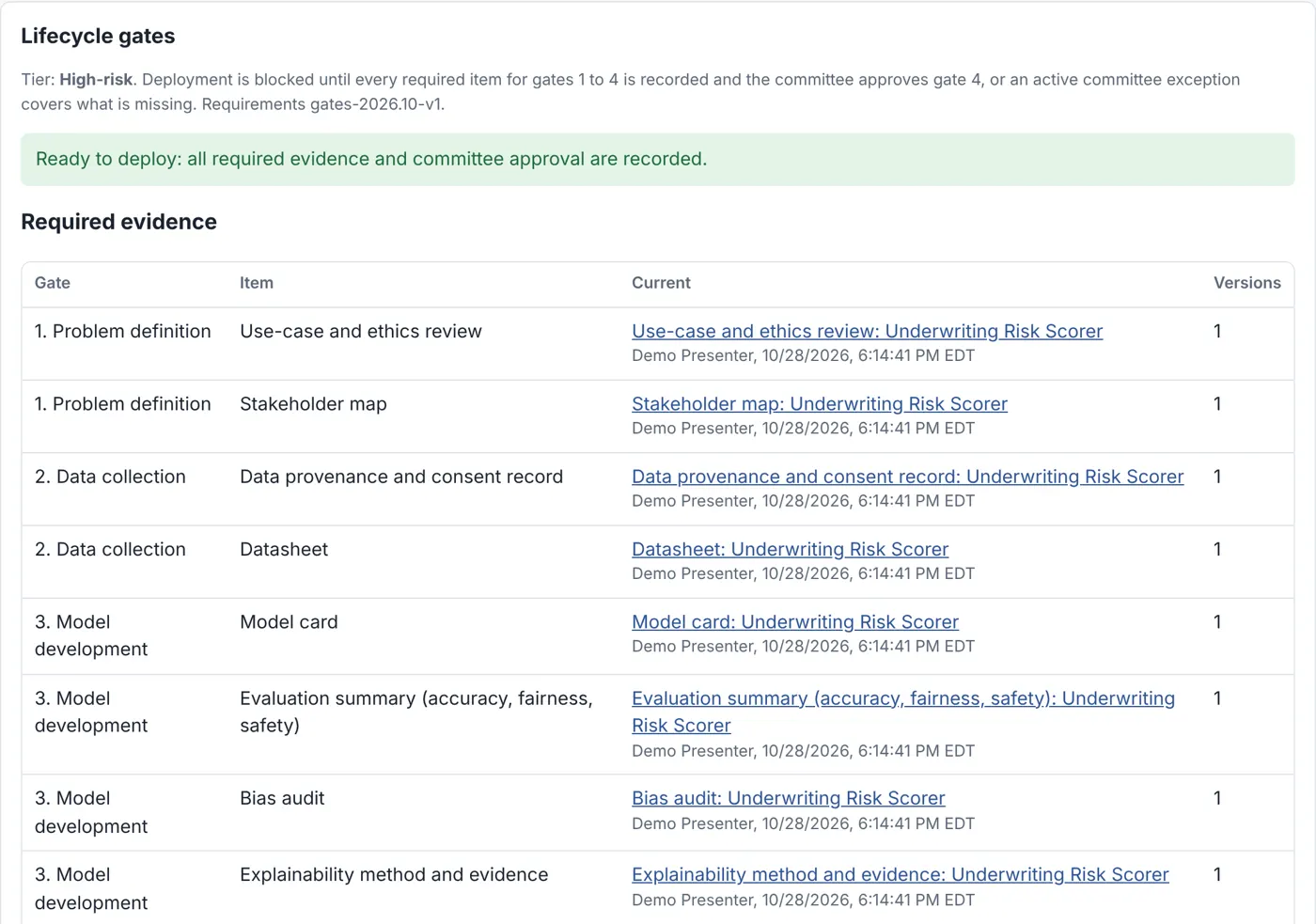
Nothing high-risk goes live without evidence and approval
Five gates from problem definition to monitoring. A high-risk system cannot be set to Deployed until gates 1 to 4 have their evidence and the committee has approved.
- Required evidence per gate, linked to where the document lives
- Committee approvals and time-limited exceptions, recorded once
- Agendas built from open intakes, gate gaps and incidents
Policies people sign, controls auditors can follow
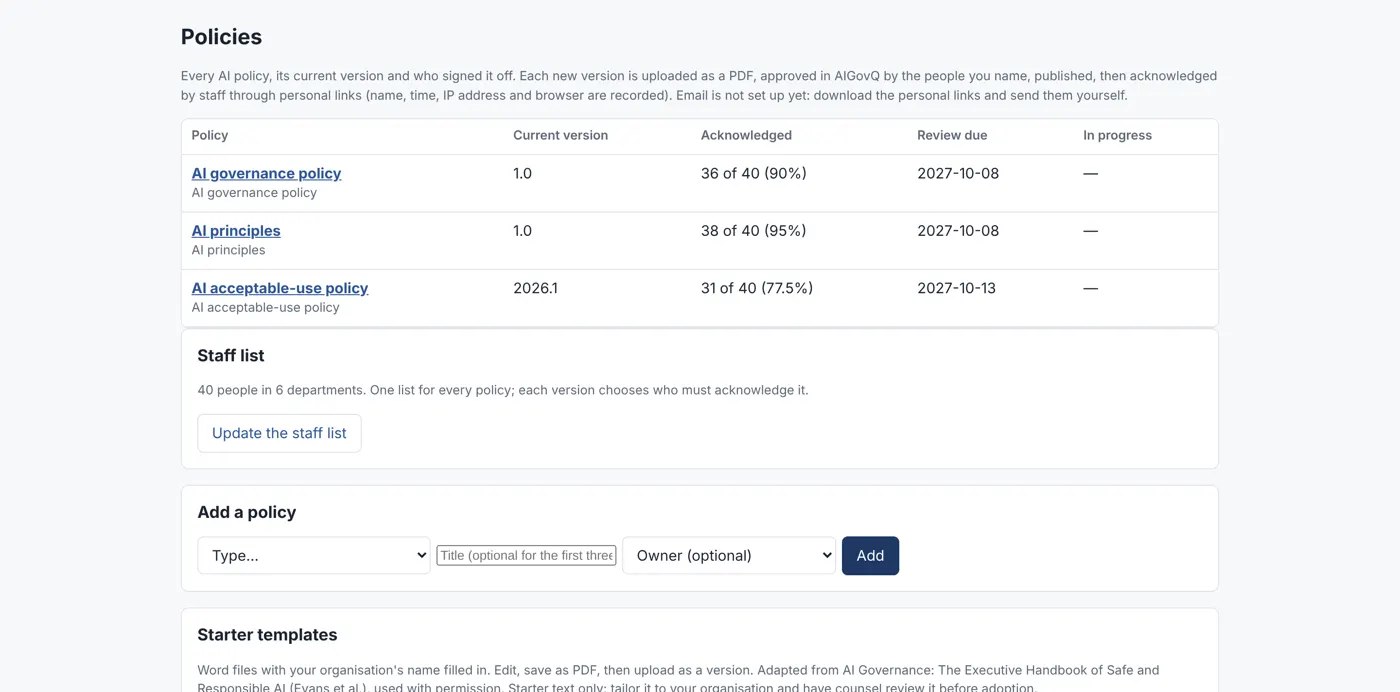
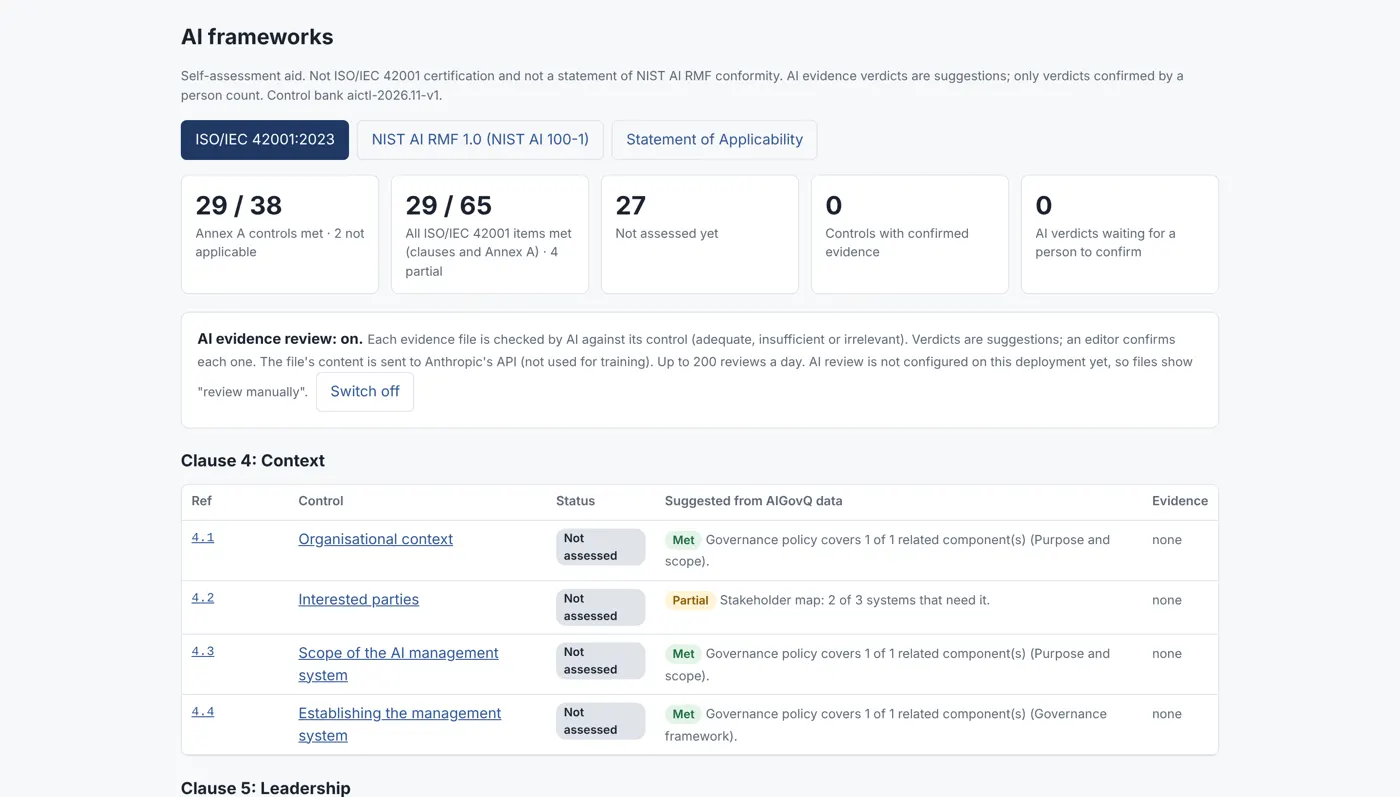
Approvers sign with their typed name, staff acknowledge the acceptable-use policy without an account, and every ISO/IEC 42001 and NIST AI RMF control has a status, owner and evidence.
- Starter templates for the AI policy, principles and acceptable use
- Acknowledgment tracking by department, with reminders
- A versioned Statement of Applicability; published policies count as evidence
When something goes wrong, the record is already there
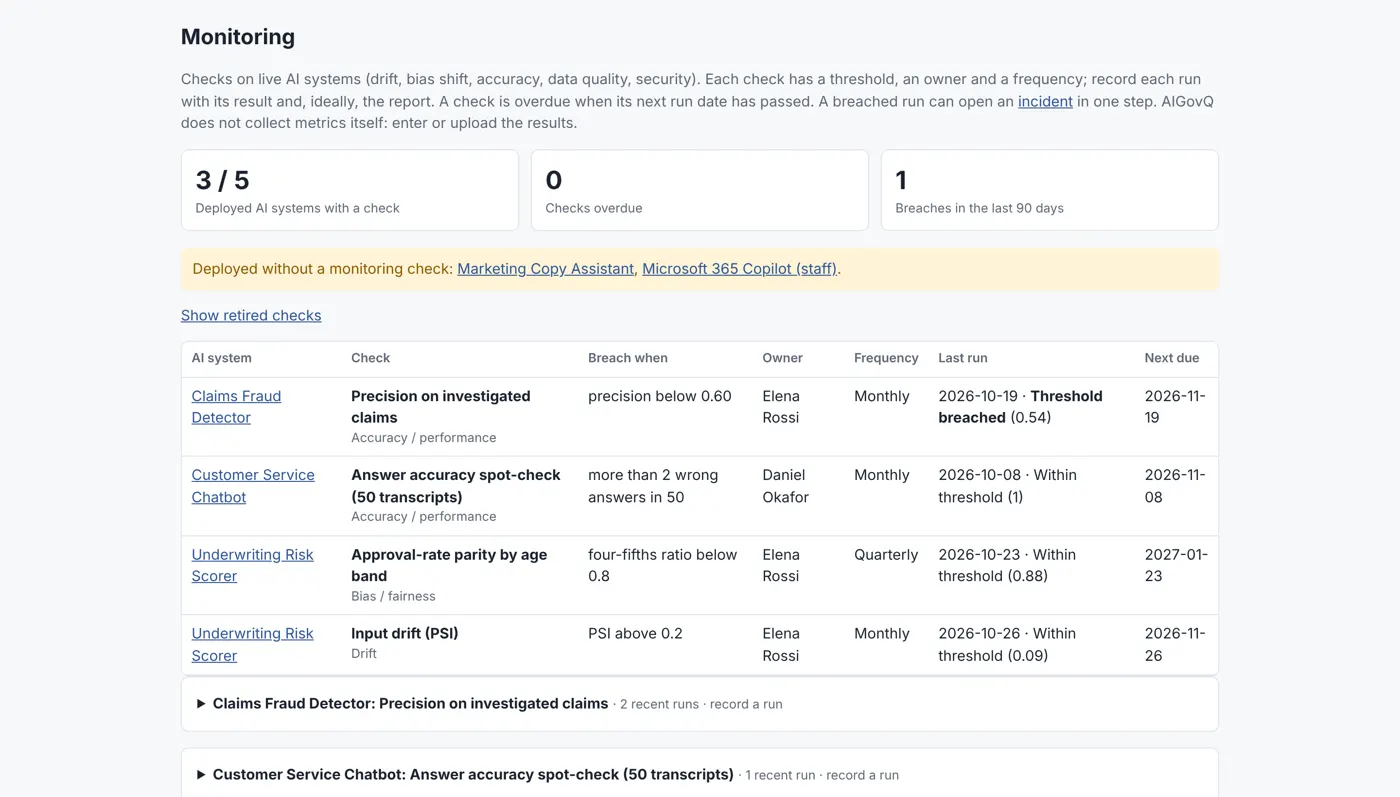
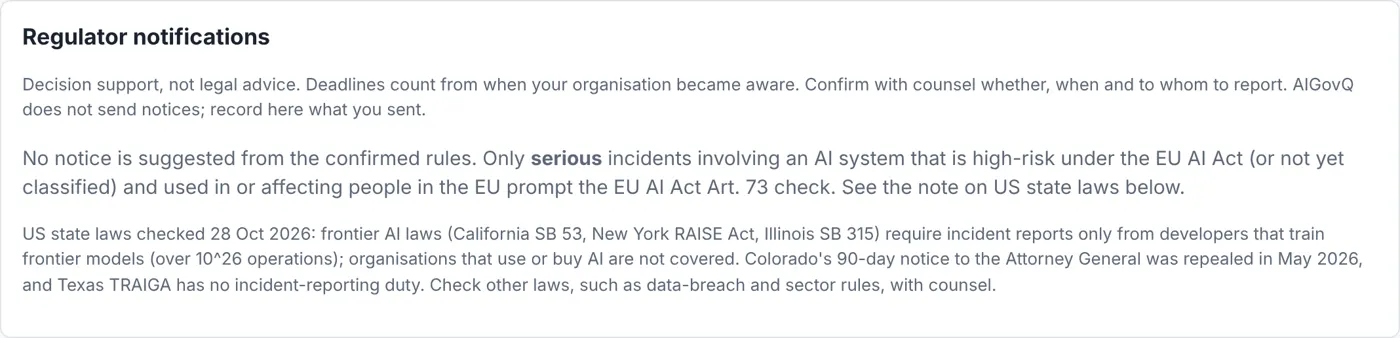
Monitoring checks record drift, bias and accuracy over time. A breach opens an incident in one click, with an owner, timeline, root cause and any regulator notice deadline.
- EU AI Act Art. 73 deadlines, with the decision recorded
- A note on which US state laws were checked, and when
- An evidence pack in Word for a regulator or insurer
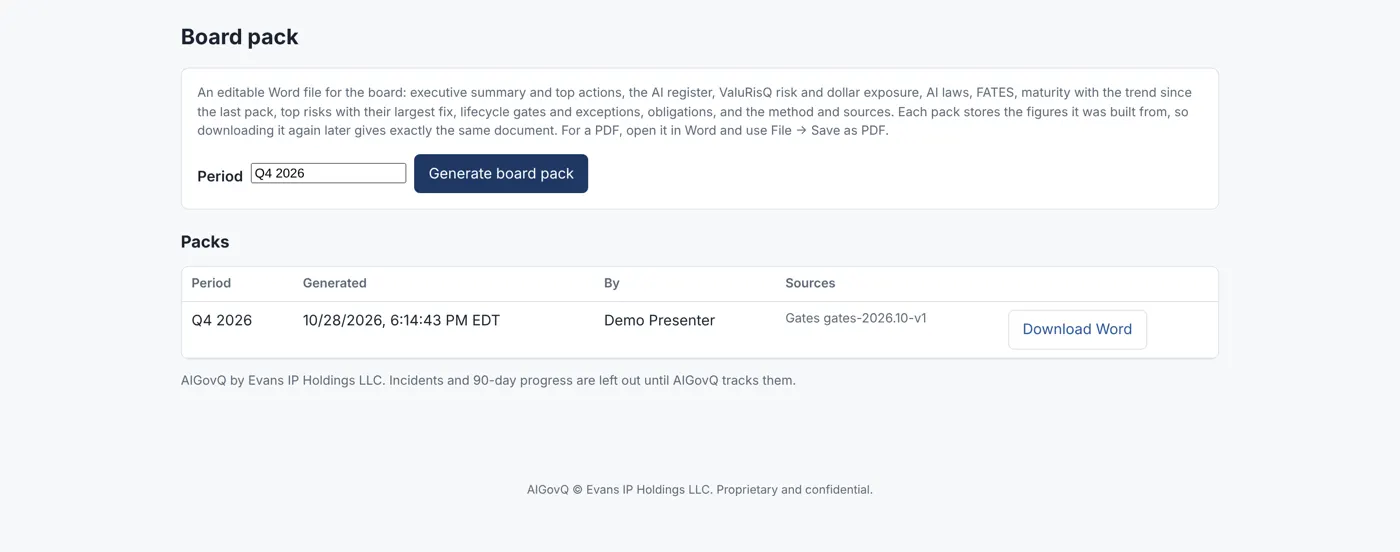
What the board sees, every quarter
One Word document: register, classifications, dollar exposure, gates, AI-law obligations, incidents, policies, frameworks and the top actions. Every pack is stored and regenerates exactly as it was.
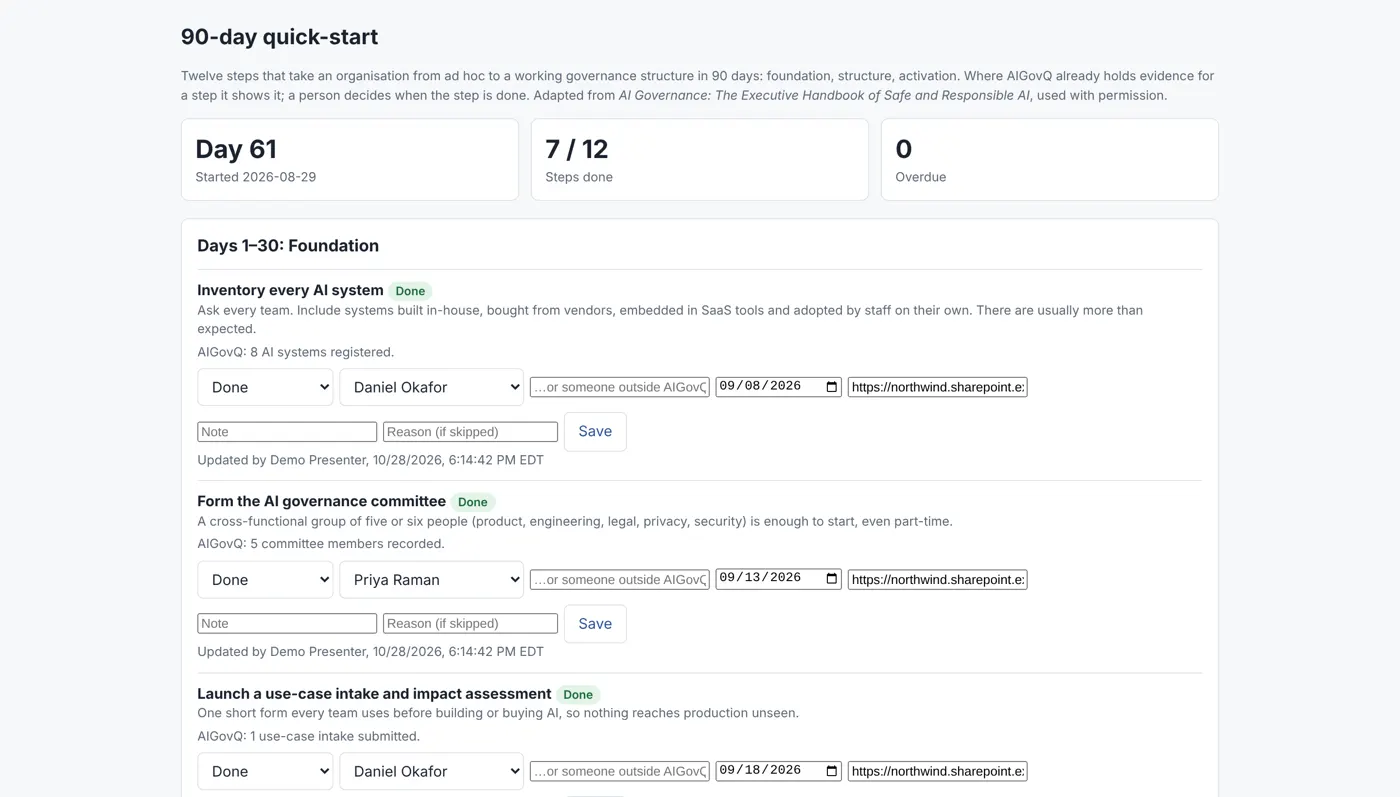
- A 12-step, 90-day starter plan with owners and evidence
- Maturity across 12 domains, from ad hoc to optimizing
- Email alerts for incidents, concerns, notice deadlines and overdue checks
Who it’s for
Built for the people who answer for AI
CISO and CRO
See every AI system, including vendor and staff tools. Put AI exposure in dollars beside cyber risk. Know who owns what, with an audit trail.
Insurers and financial services
Classify underwriting, claims and hiring models for the EU AI Act. Gate them before go-live. Keep the written AI programme state insurance regulators ask for.
General Counsel and compliance
Signed policies, minuted decisions, ISO/IEC 42001 readiness with a Statement of Applicability, incident notices and evidence packs in Word.
What’s included
One application, from intake to board pack
Regulation
The dates are fixed. The evidence has to exist.
EU AI Act dates as amended by Regulation (EU) 2026/1744, checked October 2026.
| Applies from | Obligation |
|---|---|
| 2 Feb 2025 | Prohibited practices |
| 2 Aug 2025 | General-purpose AI models |
| 2 Aug 2026 | Transparency duties (Art. 50) |
| 2 Dec 2027 | High-risk systems: insurance pricing, hiring, credit |
| 2 Aug 2028 | High-risk systems under product-safety law |
Serious incidents
For high-risk systems used in the EU, AIGovQ shows the Art. 73 deadline (15, 10 or 2 days) and records your decision.
Insurance regulators
27 states and D.C. have adopted the NAIC AI Model Bulletin, which expects a written AI programme with controls and vendor oversight.
US state laws
Checked against primary sources. Colorado’s consumer-notice rules for automated decisions apply from 1 January 2027.
Security
Built for the data you govern
What is in place today, stated plainly. The full security FAQ and data processing agreement are available on request.
- Password plus authenticator app for every user, with lockout on repeated failures
- Each organisation’s data isolated by forced row-level security in the database
- Full audit log; evidence, approvals and signatures are append-only
- Hosted in the United States: Vercel and Neon Postgres on AWS US East
- Whole-application security review, with every high and medium finding fixed
- Optional AI evidence review only; a person always decides, and admins can turn it off
- Not yet held: SOC 2, ISO/IEC 27001, third-party penetration test
FAQ
Common questions
How does AIGovQ show risk in dollars?
Through ValuRisQ. You link each AI system to the systems, processes or vendors it touches, and AIGovQ shows a residual risk score and data-theft and interruption exposure in dollars. The figures are estimates for setting priorities. Without ValuRisQ, everything else works and no dollar figures are shown.
Will it make us compliant or certified?
No product can. AIGovQ is decision support: every rule shows its source and the date it was checked, and your counsel decides. It supports readiness for ISO/IEC 42001 and the NIST AI RMF; certification is done by an accredited body.
Can it stop a risky system going live?
Yes. A high-risk system cannot be set to Deployed until the evidence for gates 1 to 4 is in place and the committee has approved gate 4, or granted a time-limited exception.
Does it connect to our ML platform?
Not yet. Monitoring results are entered or uploaded, and bias and drift metrics can be calculated in your browser from a CSV that never leaves your computer.
How do we get started?
Import your AI inventory by CSV, invite your team and follow the built-in 90-day plan. Starter templates cover the AI governance policy, principles and acceptable-use policy.
How much does it cost?
Pricing depends on your number of AI systems and users. Contact us for a proposal.
Whitepaper
Pricing AI Risk
From an AI inventory to board-ready dollars: what regulators expect now, why boards need dollars, five steps, a worked example, a 90-day plan and a board checklist.
Request your copy
Email us with “Whitepaper” in the subject and we’ll send the PDF.
ariel@evansipholdings.com
See it in 30 minutes on a live demo organisation
We’ll walk one AI system from intake to board pack, with your questions in mind. Contact us for pricing.